TL;DR
- •This blog is for Dubai residents, busy professionals, and families dealing with oil and grease stains on clothes, kanduras, and abayas, and it covers exactly how to treat them at home before they become permanent.
- •Oil stains do not wash out with water alone because oil is hydrophobic. Dish soap or a proper degreaser is what actually breaks the stain down.
- •Dubai's hard water can reduce how well some detergents cut through grease, which may make oil stains more difficult to remove than in areas with softer water.
- •Fresh stains and heat-set stains need different approaches. Once a stain has been through the dryer, blotting and baking soda alone will not be enough.
- •If a stain survives two treatment attempts, or sits on a kandura, abaya, or delicate fabric, professional treatment is the safer next step, not another round of home remedies.
Oil stains are among the most frequently experienced laundry difficulties in Dubai and also one of the least understood. Most people treat an oil stain the same way they would treat a coffee spill or mud mark, which is exactly why the stain doesn't come out. Oil stains behave differently from virtually all other stain types, and the local climate and water supply affect them in their own way.
This guide covers why oil stains are so resistant, how to treat one properly at home, what special considerations apply to kanduras and abayas, and when it's better to leave these garments to a professional laundry service.
Also Read:
Why Oil Stains Are Harder to Remove Than Most Stains
Oil and water do not mix. To the annoyance of anyone who has ever washed a grease stain, this is basic chemistry, but it makes for a frustrating laundry fact: when you put a grease stain in the washing machine, water alone cannot dissolve the oil because oil repels water.
The substances that actually remove an oil stain have one end attracted to oil and another end attracted to water. Dish soap contains surfactants that make it much better at breaking down grease than regular laundry detergent. That's also why a "washed" stain can come back after the clothes have dried. A wash cycle might dilute the stain without fully removing it, and it reappears once the fabric dries out.
There's a second factor specific to living in Dubai: the water here is quite hard, with a higher mineral content than most laundry advice written elsewhere accounts for. Hard water minerals can reduce the cleaning efficiency of some detergents, making grease stains harder to remove. This is one of the most overlooked reasons an oil stain seems to "never go away" in Dubai households, even when people take the right steps.
Common Sources of Oil Stains in Dubai Households
Understanding where stains come from helps you choose the right first move.
- Food and cooking oil. Shawarma drippings, biryani oil, ghee, and salad dressing are everyday culprits, especially on collars, cuffs, and lap areas.
- Body oil and sweat. Dubai's heat means more perspiration, and sweat mixed with natural skin oils builds up at collars and underarms faster here than in cooler climates. This is a major reason kanduras develop a yellowish shadow at the neckline over time, even with regular washing.
- Sunscreen and skincare products. Daily sunscreen use, almost a necessity given the UAE sun, leaves an oily residue on collars and sleeves that behaves much like a light grease stain.
- Automotive and outdoor grease. Car maintenance, parking-related grease, and general outdoor grime pick up petroleum-based oils that need a slightly different treatment than food oils.
Each of these is still, chemically, an oil stain. The treatment logic below applies to all of them, with fabric-specific notes where they matter.
Treating a Fresh Oil Stain: Step by Step
Speed matters more with oil than almost any other stain type. The longer oil sits, the deeper it works into the fibres.
- Blot, never rub. Use a clean paper towel or cloth to lift excess oil off the surface. Rubbing pushes the stain deeper into the weave and spreads it outward.
- Scrape off any solids. If there's food residue on top of the oil, use a dull knife or spoon edge to lift it away before treating the stain underneath.
- Apply dish soap directly. A concentrated dish soap works better here than regular laundry detergent because it's formulated specifically to break surface tension on grease. Work it gently into the fabric with your fingers or a soft brush.
- Let it sit for 10 to 15 minutes. This dwell time is what allows the surfactant to actually penetrate and loosen the oil, not just sit on top of it.
- Rinse with warm water, checking care labels first. Warm water helps liquefy the oil so it lifts out more easily than it would in cold water.
- Wash on the warmest safe cycle, again per the care label, ideally with a stain-focused detergent.
- Check before drying. This is the step people skip. If any shadow of the stain remains, do not put the garment in the dryer. Air dry it instead and repeat treatment.
That last step is what decides whether an oil stain disappears or becomes permanent.
Why You Should Never Dry a Garment With an Oil Stain Still Visible
This deserves its own section, since it's one of the most common mistakes people make when removing oil stains, and an easy one to fall into, especially in Dubai.
Heat causes the remaining oil to bond more firmly with fabric fibres, making the stain much harder to remove. After that point, even what would previously have washed out can become a set mark requiring much tougher treatment, or professional intervention, to remove.
In Dubai specifically, quick machine drying is a way of life given the volume of laundry and pace of life. But if any oil mark is still visible, it's best to air dry the garment and check it in natural light before it goes anywhere near a dryer.
How to Remove Set-In or Dried Oil Stains
If a stain has already been through a wash and dry cycle, the approach needs to be more deliberate.
- Re-wet the stained area with warm water to soften the set-in oil.
- Apply a concentrated treatment, either dish soap worked in with a soft-bristled brush, or a store-bought enzyme-based pre-treatment spray.
- Let it dwell far longer this time. Where a fresh stain needs 10 to 15 minutes, a set-in stain often needs several hours, sometimes overnight, to fully re-loosen.
- Wash again on the warmest safe setting for the fabric.
- Air dry and inspect in natural light, not indoor lighting, since oil stains can look gone under artificial light and still show up outdoors.
- Repeat once more if needed. If the stain persists after two full attempts, further scrubbing usually does more damage to the fabric than good, and it's time to consider professional treatment instead.
Caring for Kanduras and Abayas With Oil Stains
Traditional garments need a softer touch, both because of the sensitivity of the fabric and dyes used, and because of the higher standard of visual appearance expected of a kandura or abaya compared with everyday clothing.
Oil-based body residue shows up more noticeably on light-coloured kanduras than on darker ones, and the classic yellow tint at collar and cuffs is usually the result of gradual skin oil and sweat buildup rather than a single stain event. Washing the garment after every one to two wears during Dubai's summer helps prevent that buildup before yellowing develops.
If the stain is an active oil or food stain on a kandura or abaya, avoid hot water and vigorous scrubbing. Many kanduras are made with fine cotton that can lose its crispness if handled too roughly, and embellished abayas can be damaged by a home stain remover. For garments worn formally or daily, it's usually safer to gently pre-treat with a fabric-safe degreaser before sending it for a professional wash and press.
When to Call in Professional Help
Home treatment works well for most fresh oil stains and even many set-in ones. But there are clear signals that it's time to stop treating it yourself:
- The stain has survived two full treatment cycles
- The garment is a kandura, abaya, or has embellishment, lining, or delicate trims
- The fabric is marked dry clean only
- The stain is from motor oil or another non-food source, which often contains additives household products can't fully break down
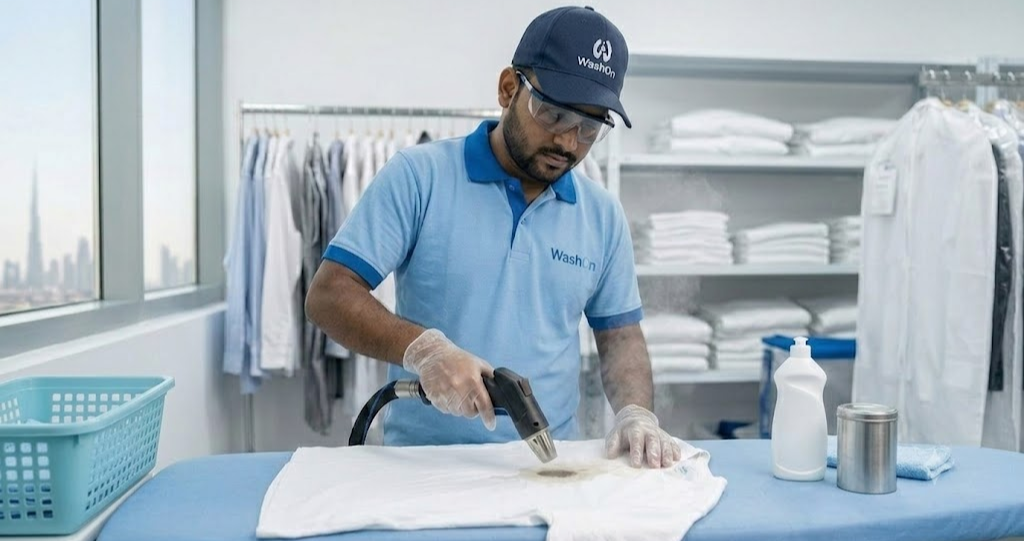
That's where a professional laundry service comes in. WashOn's in-house Dubai cleaning facility pre-treats oil and grease stains using solvents that aren't feasible at home, and the process runs entirely in-house rather than through an outsourced third party, meaning garments stay under one accountable chain of care from pickup to delivery.
There's no need to leave a stained shirt at the back of the closet waiting for a free weekend. With free pickup and delivery and a 24-hour turnaround for standard laundry, just place it in the bag and WashOn will pick it up.
WashOn's professional dry cleaning service pre-treats oil and grease stains with solvents that are not practical to use at home.
no scrubbing required.
Conclusion
Oil stains are tough, but not impossible, with the right treatment at the right time. Don't rub, use dish soap or a proper degreaser instead of water alone, and, most importantly, don't dry the garment until the stain is completely gone. Dubai's heat and hard water make oil stains a little more challenging than average, so these steps matter here more than in most laundry guides written for other climates.
If a stain is proving difficult, or it's on a kandura, abaya, or something you don't want to risk, professional treatment is the safer bet. Pick up your preferred pieces with WashOn and let the in-house team take care of the rest, no need for the donation pile.
Book a laundry pickup through the app, website, or WhatsApp, and have your clothes collected and returned clean, stain-free, and ready to wear within 24 hours.
Frequently Asked Questions
Can toothpaste remove oil stains from clothes?
Toothpaste is sometimes suggested online, but it isn't formulated to break down oil the way dish soap is. It can also leave its own residue on fabric. Stick to a concentrated dish soap or a purpose made pre-treatment for reliable results.
Does vinegar remove oil stains?
Vinegar may help remove detergent residue from fabric, but it isn't an effective degreaser. For oil stains, dish soap or a dedicated stain remover is far more effective. It works better as a supporting treatment than a standalone solution.
Why does an oil stain disappear when wet and come back once fabric dries?
This happens when the wash cycle has diluted the stain without fully removing the oil. As fabric dries, remaining oil becomes visible again. It's a sign the garment needs another treatment round before drying, not that the stain is gone for good.
Is it safe to use bleach on an oil stain?
No. Bleach doesn't break down oil, and it can actually set the stain further while risking damage or discolouration to fabric, particularly on coloured garments.
How often should a kandura be washed to prevent oil related yellowing?
In Dubai's summer heat, washing after every one to two wears helps prevent the sweat and body oil buildup that causes yellowing at the collar and cuffs. Regular washing is far easier than treating a set-in yellow stain later.
What should I do if an oil stain won't come out even after two wash attempts?
Stop treating it at home. Repeated scrubbing and washing can damage the fabric without removing the stain. At this point, professional treatment with proper degreasing agents gives the garment its best remaining chance, and WashOn's team can assess and treat it as part of a standard pickup.