TL;DR
- •This blog is for Dubai homeowners, expats, and villa residents who want to understand how professional curtain dry cleaning works and why fabric type determines everything.
- •Every curtain fabric, silk, velvet, linen, sheer, blackout, requires a completely different cleaning approach, and using the wrong method causes irreversible damage.
- •Professional curtain dry cleaning involves a structured process: fabric inspection, pre-treatment, solvent-based cleaning, steam finishing, and quality checks, not just a standard wash.
- •Dubai's climate (desert dust, AC cycles, UV exposure, coastal humidity) makes curtains deteriorate faster than in cooler climates, which is why professional care matters more here.
- •If your curtains are lined, embroidered, pleated, or made from natural fibres, skip home washing entirely and book a professional curtain dry cleaning service in Dubai instead.
Most people do not think about their curtains until they look visibly dull, dusty, or discoloured. By the time that happens, months of dust, cooking residue, desert particulates, and allergens have already settled deep into the fabric.
The bigger problem is what happens next. Many homeowners pull down their curtains and either throw them into the washing machine or attempt a home wash, and ruin an expensive pair of drapes in the process. Silk shrinks. Velvet loses its pile. Blackout linings separate. Embroidery distorts. These are not uncommon outcomes; they are what happens when fabric-specific care is ignored.
Curtain dry cleaning is not a one-size-fits-all process. Fabric type, lining, and construction all determine how a pair of curtains should be handled. This blog explains exactly what professional curtain cleaning experts do differently for each curtain fabric, and why that expertise matters so much in a city like Dubai.
Related Blogs
- How Express Laundry Services Help You Save Time and Energy
- Laundry Services in Dubai: The Complete 2026 Guide
- Which Dubai Laundry Services Actually Offer Same-Day Delivery?
Why Curtain Dry Cleaning in Dubai Demands a Different Standard
Dubai's environment is uniquely demanding on home textiles. Most homeowners do not realise how many forces are working against their curtains at any given time.
Desert dust is the most obvious one. Fine sand particles from surrounding terrain make their way into apartments and villas continuously, particularly in areas like Al Barsha, Arabian Ranches, and Jumeirah. These particles embed themselves deep into fabric fibres, creating a layer of grime that neither vacuuming nor a standard wash can fully remove.
Then there is air conditioning. Dubai homes run AC almost year-round, and constant cycling of cooled, dried air pulls moisture out of natural fibres like silk and linen, making them brittle over time. Combined with intense UV exposure from Dubai's sunlight, which fades colours and weakens fabric structure, curtains in this city face conditions that significantly accelerate wear.
Coastal humidity in areas like Dubai Marina, Palm Jumeirah, and JBR adds another layer of complexity. Moisture trapped in heavy drapes creates conditions where mould and mildew can develop inside fabric, often invisibly, until the smell becomes noticeable or the fabric starts to weaken.
This is why professional curtain dry cleaning in Dubai is not simply about aesthetics. It is about maintaining the structural integrity, hygiene, and longevity of textiles that are under real environmental pressure.
Expert Inspection Process: Where Curtain Dry Cleaning Actually Begins
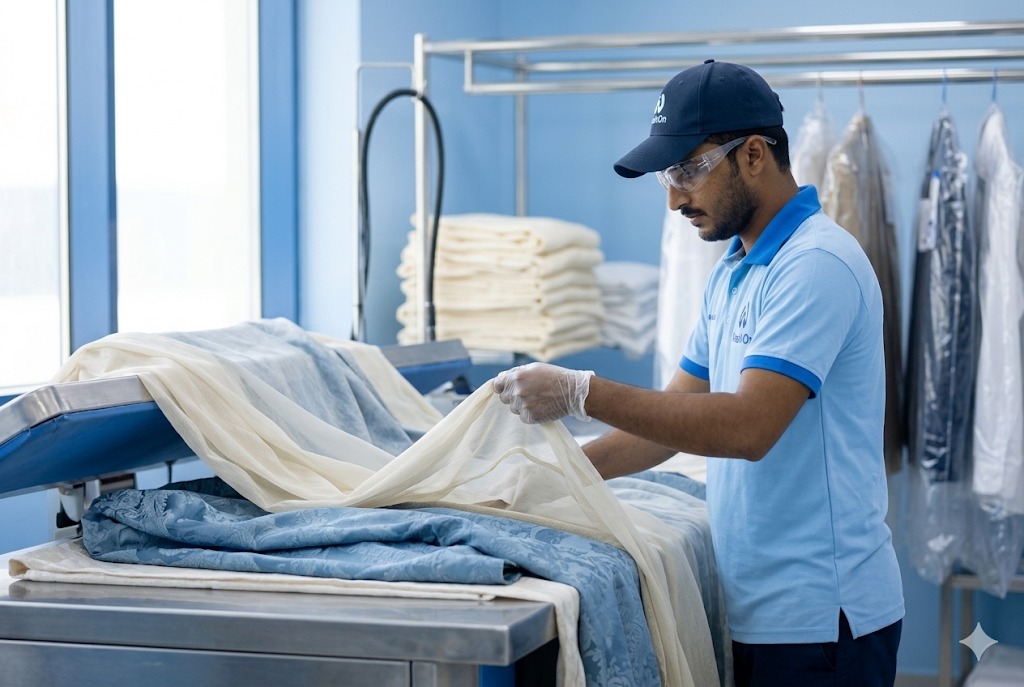
Before a single curtain goes near any cleaning solution, a trained professional does something most homeowners skip entirely: a thorough fabric inspection.
This step identifies fibre composition, checks for existing damage, assesses stain types and their likely cause, and determines whether the curtain has a lining, embroidery, hooks, or other elements that need special handling.
Care labels are checked (international care labelling standards), but professionals do not rely solely on them. A label that says “dry clean only” confirms the method (learn more about our dry cleaning service in Dubai); it does not communicate the nuances of how to treat a stubborn water stain on velvet versus a cooking oil residue on linen. That judgment comes from training and experience.
Spot testing is also standard at this stage. A small, hidden area of fabric is tested with the intended cleaning agent to check for colour fastness, whether dye bleeds or transfers when solvent makes contact. This one step prevents a great deal of potential damage and is something home cleaning simply cannot replicate.
Once inspection is complete, the expert knows exactly which cleaning method to apply, and that decision varies significantly by fabric.
Curtain Dry Cleaning by Fabric Type: What Experts Actually Do
Silk Curtains
Silk is one of the most beautiful curtain fabrics and one of the most unforgiving when handled incorrectly.
The core problem with silk and water is that moisture causes fibres to swell unevenly, leading to watermarks, texture distortion, and in some cases permanent discolouration. Silk dyes are also prone to bleeding, so even brief exposure to water without careful pre-testing can ruin a panel.
Expert dry cleaners use solvent-based cleaning agents specifically formulated for delicate natural fibres. These solvents lift dirt, dust, and odours without introducing moisture into the weave. Temperature is kept low throughout, and fabric is handled with minimal mechanical action, no scrubbing, no agitation.
After cleaning, silk curtains are steam finished using controlled steam to restore their natural drape and sheen. They are never pressed with direct iron contact, which would flatten fibres and remove their characteristic lustre.
If your silk curtains have embroidery or metallic thread work, common in luxury Dubai villa installations, these areas are treated individually to prevent thread contraction or colour bleed.
Velvet Curtains
Velvet's rich texture and deep colour make it one of the most popular choices for formal living rooms and master bedrooms in Dubai. It is also one of the most technically demanding fabrics to clean.
Velvet has a raised pile of short, dense loops of fibre that give it that distinctive softness and depth. Any incorrect cleaning method can crush or flatten this pile permanently. Machine washing does this almost every time, even on a gentle cycle.
Professionals approach velvet curtains with a combination of gentle solvent cleaning and directed steam. Steam is applied in a direction that lifts the pile, restoring its texture rather than flattening it. No direct pressing, no tumble drying, no mechanical agitation.
For heavy velvet drapes with blackout linings, a common configuration in Dubai homes where light control is essential, the lining and velvet faces are treated as separate materials that happen to be joined. Each is cleaned according to its own requirements, without compromising the other.
Linen Curtains
Linen is a natural fibre with excellent breathability, which makes it popular in Dubai homes where a clean, airy aesthetic is valued. Its weakness is its tendency to shrink and wrinkle significantly when exposed to heat or excessive moisture.
Even mild heat during washing can cause linen to shrink by several centimetres, enough to make full-length floor curtains noticeably short after a single incorrect wash. This is irreversible.
Professional dry cleaners pre-treat any staining, tea, coffee, cooking oil, before the main cleaning cycle to ensure complete removal without over-treating surrounding fabric. Post-cleaning, linen curtains are carefully pressed while slightly damp to restore their natural texture and reduce wrinkling before being packaged for return.
Sheer and Voile Curtains
Sheers are deceptively fragile. They look lightweight and simple, which leads many homeowners to assume they can be thrown into any wash cycle. In practice, sheer fabrics tear, snag, and distort surprisingly easily.
The fine weaving of voile and sheer fabrics means that any mechanical stress, rough agitation, high spin speed, bundling in a machine, can cause pulls, tears, or permanent distortion. Sheers are also prone to colour loss from harsh detergents, often coming out a dingy off-white even after a single improper wash.
Professional handling involves a fabric-appropriate cleaning process with minimal agitation, followed by careful drying and steam finishing to preserve the curtain's shape. Steam is used to remove any minor creasing without direct contact with the fabric surface.
One underappreciated fact: sheer curtains in Dubai homes near open windows accumulate fine sand particles that are not visible to the naked eye but create a rough texture when rubbed between fingers. Professional curtain dry cleaning removes this particulate effectively in a way that home washing cannot.
Blackout Curtains
Blackout curtains are more structurally complex than they appear. Most are constructed from multiple layers of decorative face fabric bonded to one or more blackout lining layers that block light and reduce heat transfer. The bonding between these layers is a critical vulnerability.
Water-based washing frequently causes layers to separate, bubble, or peel. Once delamination begins, it cannot be reversed. A single improper wash can reduce a set of expensive blackout curtains to something unusable.
Dry cleaning is the correct method for virtually all blackout curtains. Solvents clean the face fabric without penetrating the bonded lining in a way that compromises adhesion. Heat is avoided throughout the process to protect the lining's coating.
For Dubai homes where blackout curtains serve the dual function of blocking intense sunlight and reducing heat gain, maintaining these curtains properly is a practical consideration as much as an aesthetic one.
Brocade, Taffeta, and Embellished Fabrics
Luxury curtain fabrics like brocade, taffeta, and embellished drapes with beadwork or embroidery require the most careful handling of all.
Brocade is woven with raised patterns, often incorporating metallic threads that are extremely sensitive to moisture. Taffeta has a characteristic crisp, rustling texture, a quality that is entirely destroyed by water exposure. Embellishments like beads, sequins, and decorative stitching can shift, unravel, or discolour if subjected to any standard cleaning process.
Professional dry cleaners treat each element of these curtains individually. Embellished sections are covered and protected during the main cleaning cycle. Metallic threads are cleaned using the most gentle solvents available. Post-cleaning finishing is done by hand to ensure no elements have shifted position.
These are curtains typically found in Dubai's premium villas, hotel-style penthouses, and high-end residential developments, and they represent a significant investment that requires professional expertise to maintain.
What Happens After Cleaning: The Finishing Process
Cleaning itself is only part of what experts do. The post-cleaning process is what gives professionally cleaned curtains their finished appearance.
After the solvent cleaning cycle, curtains are inspected again to confirm all staining and soiling has been removed. Any areas requiring additional treatment are spot-cleaned before the finishing stage.
Steam pressing restores the shape, drape, and texture of the fabric. For pleated curtains, each pleat is carefully pressed back into its original form. For curtains with weighted hems, weights are checked and repositioned if necessary. Hooks, rings, and heading tape are inspected and replaced where needed.
The final product is packaged carefully, typically hung or folded with protective covering to prevent creasing during transport, and returned to the customer ready to rehang.
At WashOn, this entire process takes place in our own in-house Dubai facility. Your curtains are never passed to a third party, which means consistent quality and direct accountability at every stage.
Signs Your Curtains Need Professional Dry Cleaning
You do not always need to wait for visible dirt before booking. Here are the clearest signals that it is time:
- A musty or stale odour that does not go away with airing
- Visible discolouration, particularly near the bottom hem or along folds
- Visible dust or haze even after vacuuming
- A noticeable change in how the curtain hangs, stiffness, uneven drape, or loss of fullness
- Staining from water, food, or cooking residue
- Post-renovation dust that has settled into fabric
- End of tenancy cleaning in advance of a move or new tenancy, see our guide on why curtain cleaning is essential for healthy indoor air
In Dubai, experts generally recommend professional curtain dry cleaning every six to twelve months depending on fabric type, location of the room, and how much exposure curtains have to dust, cooking, and sunlight.
Why Choose WashOn for Curtain Dry Cleaning in Dubai
WashOn is trusted by over 50,000 Dubai households for professional laundry and dry cleaning, and curtain care is handled with the same attention to detail as every other garment we clean.
Here is what you can expect when you book curtain dry cleaning in Dubai with WashOn:
- Free pickup and delivery: we collect from your door and return your curtains ready to rehang
- In-house Dubai facility, your curtains never leave our own professional cleaning team's hands
- Fabric-specific treatment: every curtain is assessed and cleaned using the method appropriate for its fabric
- 4.9-star customer rating: consistent results across thousands of households
- Easy booking via WashOn website, app, or WhatsApp
Whether you have sheer voile panels in a JVC apartment, velvet drapes in a Dubai Hills villa, or embellished brocade curtains in a Palm Jumeirah penthouse, WashOn handles them with the care they deserve.
Conclusion
Curtain dry cleaning is not simply a cleaning task. It is a fabric-specific, technically precise process that determines whether your curtains come back looking better than before, or come back damaged beyond repair.
Every fabric has a correct method: silk needs solvent care and controlled steam; velvet needs pile-preserving techniques; blackout curtains need layer-safe cleaning; embellished fabrics need element-by-element handling. Getting it wrong at home is easy, and the consequences are usually permanent.
In Dubai especially, where environmental conditions put constant pressure on home textiles, the case for professional curtain dry cleaning is strong. The investment in proper care is far smaller than the cost of replacing curtains that have been irreversibly damaged.
Ready to have your curtains professionally cleaned? Book curtain dry cleaning in Dubai with WashOn today. Free pickup, in-house professional care, and delivery right back to your door.
your curtains?